Navigazione
Accesso utente
SIAMO ANCHE QUI:


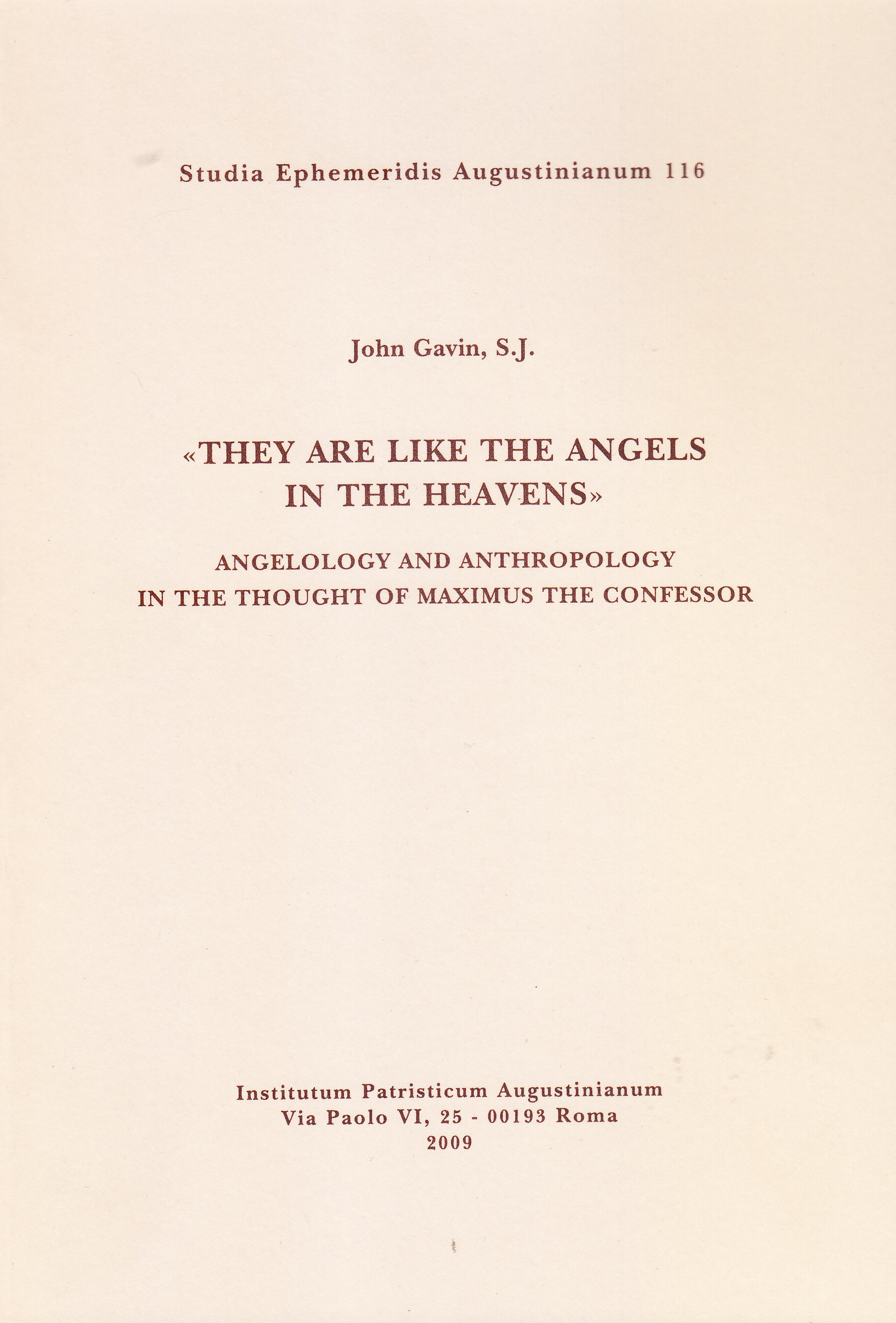
«They are like the Angels in the Heavens». Angelology and Anthropology in the Thought of Maximus the Confessor
CODICE: ISBN 8879611267 EAN 9788879611268
AUTORE/CURATORE/ARTISTA :
Author: John Gavin
EDITORE/PRODUTTORE : Institutum Patristicum Augustinianum
COLLANA/SERIE : Studia Ephemeridis Augustinianum, 116
DISPONIBILITA': Disponibile
TITOLO/DENOMINAZIONE:
«They are like the Angels in the Heavens». Angelology and Anthropology in the Thought of Maximus the Confessor
PREZZO : EUR 45,00€
CODICE :
ISBN 8879611267
EAN 9788879611268
AUTORE/CURATORE/ARTISTA :
Author: John Gavin
EDITORE/PRODUTTORE:
Institutum Patristicum Augustinianum
COLLANA/SERIE:
Studia Ephemeridis Augustinianum, 116
ANNO:
2009
DISPONIBILITA':
Disponibile
CARATTERISTICHE TECNICHE:
322 pages
Paperback
cm 16,5 x 24 x 1,7
gr 531
DESCRIZIONE:
After centuries of relative obscurity in the West, Maximus the Confessor finally received his due recognition through the remarkable scholarly efforts of numerous theologians during the resourcement of the twentieth century. The lack of critical editions and the notorious complexity of Maximus' Greek certainly marred some early efforts to recover his thought. Yet, thanks to such luminaries as H.V. von Balthasar, W. Volker, and L. Thunberg, the vision of this great ascetic, theologian, and martyr has become the object of a growing number of studies and the inspiration for modern approaches to speculative theology.
Many scholars dedicated their efforts toward a general analysis of Maximus' methodology and the identification of his sources. Others concentrated upon the most important areas of his thought: his struggle against a form of "Origenism" in the monastic communities; his spirituality and ascetic doctrine; and his Christology and Trinitarian theology, in conjunction with his adherence to Chalcedonean/neo-Chalcedonian doctrine, and his involvement in the monothelite and monoenergist controversies.
Index:
page 5 Acknowledgments
7 Introduction
CHAPTER ONE: The problem of "angelism"
19 1. The Scriptures
19 1.1. The Old Testament
22 1.2. The New Testament
25 2. The speculations of Origen
25 2.1. The Platonic tradition
27 2.2. Philo
31 2.3. Origen
37 3. Evagrius Ponticus
46 4. Origenism
52 5. An alternative vision: Dionysius the Areopagite
52 5.1. Proclus
56 5.2. Dionysius
57 5.2.1. The nature of the angels
58 5.2.2. The angelic hierarchy
61 5.2.3. Demons
62 6. Conclusion
65 PART ONE
CHAPTER TWO: The problem of the henad and the doctrine of the logos/logoi
67 1. The problem of the henad
68 2. The divine skopos
70 3. The Logos/logoi
70 3.1. The "Logos"
71 3.2. The "logoi"
73 3.3. The "logos" as the power of reason
CHAPTER THREE: Distinguishing angel and man
78 1. The creation of the angels
78 1.1. The distinct "logos" of the angel
79 1.2. "Spiritual" creation
79 1.2.1. The problem of incorporeal substance in antiquity
82 1.2.2. The concept of "spiritual" or "immaterial" substance: Dionysius
85 1.2.3. The concept of "incorporeal" or "intelligible" substance: Maximus
85 1.2.3.1. Defending the incorporeal nature of the soul
88 1.2.3.2. The dyadic structure of incorporeal or spiritual substance
95 1.3. Angelic knowledge
101 1.4. The angelic hierarchy
106 1.5. Angelic will and free choice
106 1.5.1. Maximus' analysis of the will
110 1.5.2. Angelic volition: natural will and self-determination
112 1.5.3. Angelic volition: deliberative will and free-choice
115 1.6. Angelic worship and praise
118 1.7. The association of the angels with "reason" (logos) and the "logoi"
124 1.8. The problem of movement, time, and place
127 1.9. Demons
131 2. The creation of man and his distinct nature
132 2.1. The divine intention for man
135 2.2. Man before the fall
137 2.2.1. The soul/body relationship
139 2.2.2. Man's original state as a composite being
143 2.3. Man after the fall
143 2.3.1. Ignorance of man's true nature
144 2.3.2. The misuse of free will
146 2.3.3. Fallen man in the divine plan
147 2.3.4. The passions
149 PART ONE: CONCLUSION
149 1. The differences between angels and men
150 2. The similarities between angels and men
153 PART TWO
CHAPTER FOUR: The relationships among men, angels, and demons in the spiritual struggle
155 1. The scope of the spiritual life
156 1.1. Restoring man's nature: return to the "logos"
156 1.2. Going beyond man's nature: divinization
158 1.3. The three stages of the spiritual life
158 1.4. The need for struggle
160 2. The attack of the demons
161 2.1. Developing the thought of Evagrius
161 2.1.1. The battle for "thoughts" (λογισμοί)
162 2.1.2. The specialization of the demons
165 2.2. The reason for the existence of demons
170 2.3. How demons attack
171 2.3.1. Perverting the λόγος and τρόπος/γνώμη
172 2.3.2. Inspiring pleasures contrary to nature
173 2.3.3. Exploiting man's temporal state
174 2.4. The victory of Christ over the tombs
175 3. The aid of the angels
177 3.1. The "fighting angel"; angels versus the demons
177 3.2. The enlightenment of the angels: bearers of the logoi
178 3.2.1. Ex. 4,24: The angel assassin
180 3.2.2. Io. 2,11-12: The two angels in the tomb
181 3.2.3. Gen. 28,12: Jacob's ladder
182 3.2.4. Mich. 6,1: angels and the prophets
184 3.3. Angels as objects for reflection
CHAPTER FIVE: Becoming īsangelos
189 1. Christian understanding of "īsangelos" prior to Maximus
194 2. The five mediations: Ambigua ad Ioannem 41
198 2.1. The first two mediations: movement toward unity
199 2.2. The third mediation: equality with the angels through the virtues and ἀπάθεια
200 2.3. The fourth mediation: equality with the angels in knowledge
202 2.4. The fifth mediation: equality with the angels through divinization
203 3. Paul's ascent into the "third heaven": Ambigua ad Ioannem 20
205 3.1. Maximus' use of Dionysius
207 3.2. The originality of Maximus' interpretation
211 4. The Mystagogia
211 4.1. Conversion and praxis: the entrance, readings, signs of peace
212 4.2. Contemplation and praise: the 'Trisagion'
213 4.3. Mystical theology, adoption, and beyond
216 5. Commentary on the Our Father: Imitating the kenosis and Ascension of Christ
222 6. Equality through grief or sadness: Epistula 4 and Questiones et Dubia 129
227 PART TWO: CONCLUSION
231 PART THREE
CHAPTER SIX: The "suffering" of men and angels: The deification of all rational creatures
235 1. The meaning of suffering (ΠΑΣΧΕΙΝ)
236 1.1. Suffering as adherence to the senses
236 1.2. Suffering as the experience of pain and sadness
238 1.3. Suffering as yielding, consenting or conceding
241 2. The Incarnation: redemption and divinization
243 3. Sharing in Christ's suffering and Crucifixion
246 3.1. The cup: modeling the will
249 3.2. Participation in the Crucifixion
251 3.3. "Going beyond": Ascending with Christ to the Father
253 4. The eternal suffering of men and angels
253 4.1. The Incarnation and the angels
256 4.1.1. The Incarnation as revelation and mystery for the angels
258 4.2. Experiencing the Cross and the Tomb
261 4.2.1. The "day of fulfillment"
262 4.2.2. The angelic mode of "suffering": Recapitulation in Christ and man
266 5. Going beyond: distinguishing man and angel in God
268 5.1. "Proportional" participation
270 5.2. The divinization of the body
275 PART THREE: CONCLUSION
CONCLUSION
277 1. Maximus' Synthesis
280 2. Why did God create the angels?
282 3. Some questions for further consideration
282 3.1. The problem of sexual distinctions
282 3.2. The problem of the deliberative will
283 3.3. The problem of angelic "personalities"
285 4. Rational beings and the glory of God
287 Abbreviations
289 Bibliography
303 Scripture
307 Ancient authors
309 Maximus
315 Modern authors
319 Index
GENERE: Libri ,Saggi ,